

During one of the coldest winters in St. Paul, Minnesota, we traveled from Providence to offer a professional development workshop for the district’s teachers. The focus was “making complex texts accessible.” We chose one of the most complicated texts we could think of—Speak, Memory by Nabokov—and built a workshop around it to demonstrate to adults how repeated encounters with a difficult text can lead to deep understanding. When we arrived on the day of the workshop, the teachers had invited students to join as well. One teacher explained that many of these students “struggled with reading.” Just to give a sense of the text’s lexical density, it begins:
The cradle rocks above an abyss, and common sense tells us that our existence is but a brief crack of light between two eternities of darkness. Although the two are identical twins, man, as a rule, views the prenatal abyss with more calm than the one he is heading for (at some forty-five hundred heartbeats an hour). I know, however, of a young chronophobiac who experienced something like panic when looking for the first time at homemade movies that had been taken a few weeks before his birth.
Our team huddled on the side of the room to discuss what to do. Do we change the text to something easier? Do we split the group? We had already planned the session and decided to move forward with Nabokov. Participants engaged in a variety of activities in which they interpreted phrases, performed passages, and collaboratively analyzed the text. At the end of the workshop, one of the students said, “Now I really want to read the whole book!”
Getting students excited about seemingly obscure or “impossible” texts has always been at the core of my teaching. When I taught English Language Learners in Mexico, we read Shakespeare’s The Tempest, To Kill a Mockingbird, and Invisible Man. One of the primary approaches we developed at our school Habla to support students through these works is what we call “turning the text.” After studying a particular passage, monologue, or poem, we take one line from it and use it as a prompt. That line becomes a structure, a sentence starter, or a question for students to write their own response. Using the opening of The Odyssey, I’ll describe ways we engage students in reading the text and responding to it with a “turning the text” approach.
Break It Down
Shakespeare and Company, a theater group based in the Berkshires in Massachusetts, has a robust educational outreach program focused on “immersing students in the world of Shakespeare.” One of their primary techniques is to get Shakespeare’s words immediately into students’ voices and bodies. They give short excerpts to small groups and ask them to “bring them to life.” From phrases, they move to monologues, with four or five students performing a single monologue collaboratively. This all happens before students have even read the play.
The effect is powerful: students feel immediately successful with the text. These embodied, collaborative experiences become a bridge into reading the larger work.
I’ve used their techniques not only with Shakespeare but with many other texts, including The Odyssey. Here is the opening Richard Fagles’s translation:
Sing to me of the man, Muse, the man of twists and turns
driven time and again off course, once he had plundered
the hallowed heights of Troy.
Many cities of men he saw and learned their minds,
many pains he suffered, heartsick on the open sea,
fighting to save his life and bring his comrades home.
But he could not save them from disaster, hard as he strove—
the recklessness of their own ways destroyed them all,
the blind fools, they devoured the cattle of the Sun
and the Sungod wiped from sight the day of their return.
Launch out on his story, Muse, daughter of Zeus,
start from where you will—sing for our time too.
We begin by engaging students directly with the text. For instance, in an activity we call Instant Sculptures, we place students in groups of five. We call out the line “plundered the hallowed heights of Troy.” Students discuss the line and have one minute to create a “stage picture” of that moment. Then we move to another line—“heartsick on the open sea”—and continue the process with several phrases. Afterward, we give each group the entire opening passage and ask them to prepare a reading of the text. They might speak some lines together, others individually, or even “remix” the sequence. The goal at this point is not necessarily to “understand” the text fully but to engage with it through movement and voice.
Comprehension
Our overall goal is for students to develop a deep understanding of the text. At this point, we shift to more traditional methods to help them read critically and closely. I’ve described one of these approaches—Tip of the Iceberg—previously (and stay tuned for many more in the near future!). It’s important to note that the earlier activities, which we might call “activating” or “entering” the text, do not necessarily build comprehension on their own. They are not end points; they must be followed by sustained reading and analysis.
Another approach we’ve used with this opening is “marking up the text”—described here with examples from The Odyssey. This allows students to argue with the text, think critically about it, and interrogate its assumptions.
Turning the Text
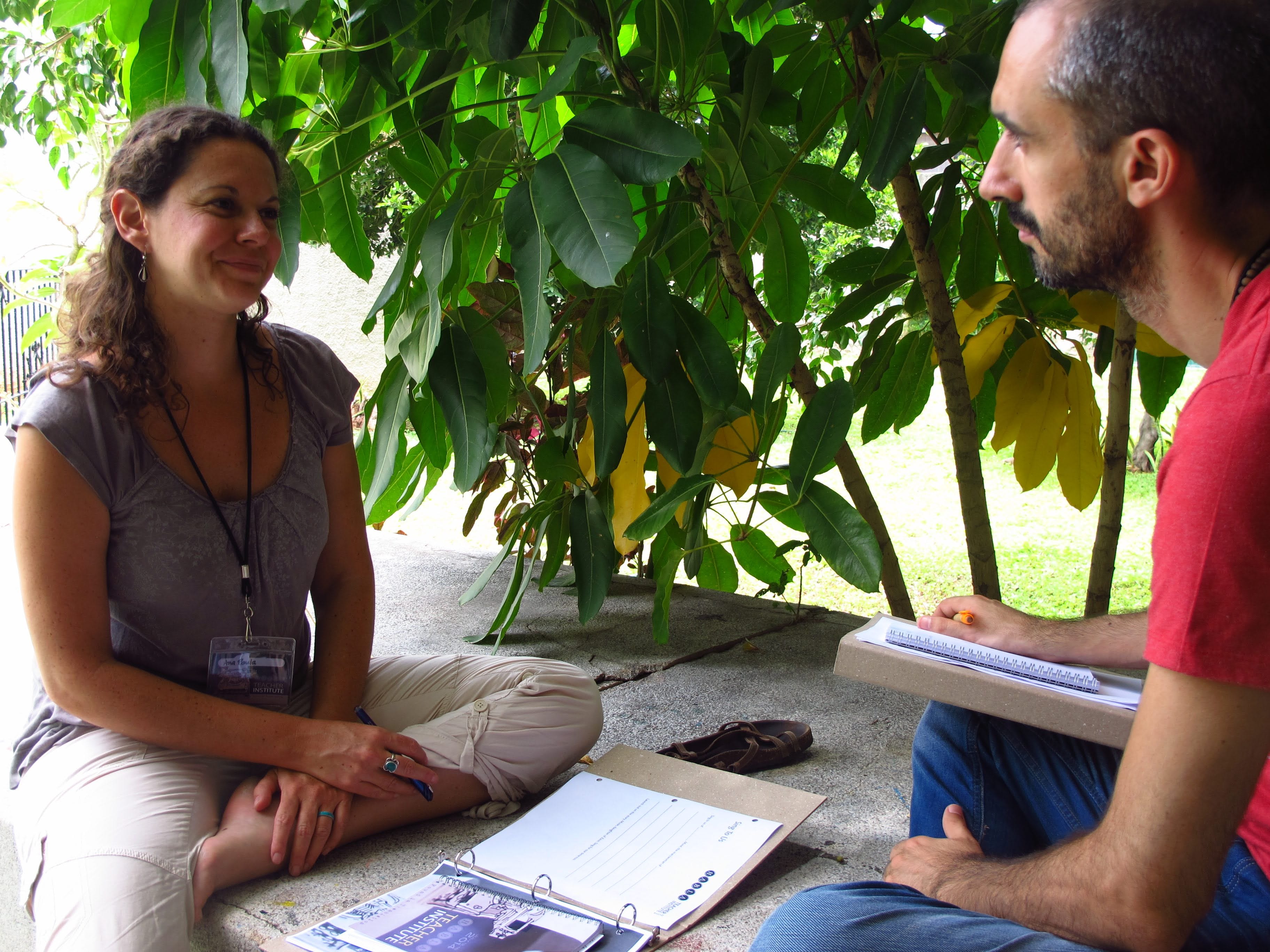
At one of our Teacher Institutes in Mérida, Mexico we spent the week on The Odyssey. Since teachers gather from around the world at Habla’s institutes, and usually don’t know each other, we are always looking for ways to build community at the start of the week. Instead of using generic team-building activities, we prefer to jump immediately into the content we’ll be exploring.
After reading the opening of The Odyssey using some of the approaches mentioned above, we wanted teachers to talk with each other, to get to know each other beyond the usual introduction of names and where they’re from. With the template below as a guide, we placed all the participants in pairs and asked them to interview each other focusing on the question, “What is heroic about your interviewee?”

This interview process allowed each person to identify and celebrate their partner. As teachers, our work centers on lifting up our students, helping them become better in some way than when they first entered our classrooms. We give of ourselves because that is the nature of our work: to celebrate others. Yet it’s often difficult to acknowledge what deserves celebration in ourselves.
We then asked them to write their tribute to the other person mirroring Homer’s “elevated language.” Participants were already immersed in Homer’s style—the prompts served as an invitation to match his heightened verse. We ended the session with teachers seated in a circle, reading their tributes aloud. The sharing of the participant’s original writing followed a deep reading of the text. This is what I love most about the classroom: moving back and forth between the texts we analyze and the “original energy” students bring to the room.