


Alright—that title may sound like a controversial question, so let’s break it down a bit. I don’t mean that students should never do homework. I mean that teachers should stop giving homework. Before we look at the difference between the two, let’s step back to consider the bigger picture.
The School Day vs. the Workday
In general, society seems to have settled on an eight-hour workday for adults. Most of us put in our day of work, then head home to enjoy time with family, watch our favorite TV series, exercise, or read a book. As adults, we talk about “putting work aside,” not sending text messages to colleagues at night, and spending quality time with our partners, families, or ourselves.
Yet for our young people, we give excessive amounts of work to take home. As a beginning English teacher, I remember assigning my students a chapter of a book to read every night—just for my class. As an adult, I’m lucky when I have the time or energy to read a chapter of a book a day! When I first started teaching, my students had six other classes.
At one private school where I taught, we eventually held a meeting and decided to limit the amount of homework each teacher could assign to thirty minutes per night—still an insane, and perhaps impossible, amount of work. In the U.S., students are in school about seven hours a day. If that time is structured well (and usually it’s not), students should be able to learn, practice, and engage in projects with their peers during the school day.
The Need for College Prep
High school educators often argue that students need excessive homework so they can “manage their time” and “prepare for college.” But in college, students are only in structured classrooms for about 12–15 hours a week (based on four to five classes of three hours each). They have much more time outside of class to pursue their studies.
That said, I’d argue colleges assign an impossible workload as well. When we proposed our class at Brown University, we were advised by the department chair to assign one academic book a week so the class would be “appropriately rigorous.”
As a college student myself, I once took a class on the Victorian novel—we had to read a Victorian novel every week. Our professor graciously gave us two weeks for Bleak House, which is over 1,000 pages. I was taking four other classes at the same time. The unspoken rule of college is that you won’t have time to read everything, so you choose accordingly.
Today’s students have many more ways to take shortcuts via AI and Google—but we shouldn’t expect any of our students to take shortcuts as a way of survival.
Following Your Passion Rather than the Assignment
The research on the benefits of homework is mixed. Some studies show small improvements on standardized test performance—but aren’t those the students who are already motivated? And is our goal really to make students better test-takers?
We also need to consider what students lose when they spend several hours on homework each night. My high-school-age daughter loves participating in after-school activities that align with her interests—currently voice lessons and archery. My middle-school-age son plays soccer for two hours every day after school.
An admissions officer from Dartmouth once said that they aren’t looking for the “perfect student”—the one with straight A’s, all the right classes, and a long list of extracurriculars. They’re looking for students with a particular passion, who stand out, who excel in something specific.
That aligns with what I saw at Brown—admissions wasn’t seeking perfect students, but interesting ones. If we assign homework every night, when do students have time to become interesting? To practice the hobbies, sports, and arts they’re passionate about?
What Students Say About Homework
Most students don’t view homework as useful or helpful. In a study of 4,317 students, researchers Galloway, Conner, and Pope found that only 6 percent of students described homework as “very useful.” Here are some comments from students in the study:
“Sometimes I get assignments that just take up a lot of time and are hardly useful. These prevent me from getting as much sleep as I’d like, and I don’t even learn from them.”
“Some work that we are given doesn’t help us in life, and I start to wonder why we even are doing it.”
“I’m stressed because I have so many pointless, mundane assignments that take up large amounts of time without actually learning anything in class. I don’t mind working if I’m actually learning something.”
Students described their homework as “boring,” “uninteresting,” “futile,” “repetitive,” “redundant,” “tedious,” “mindless,” and “nonsense.”
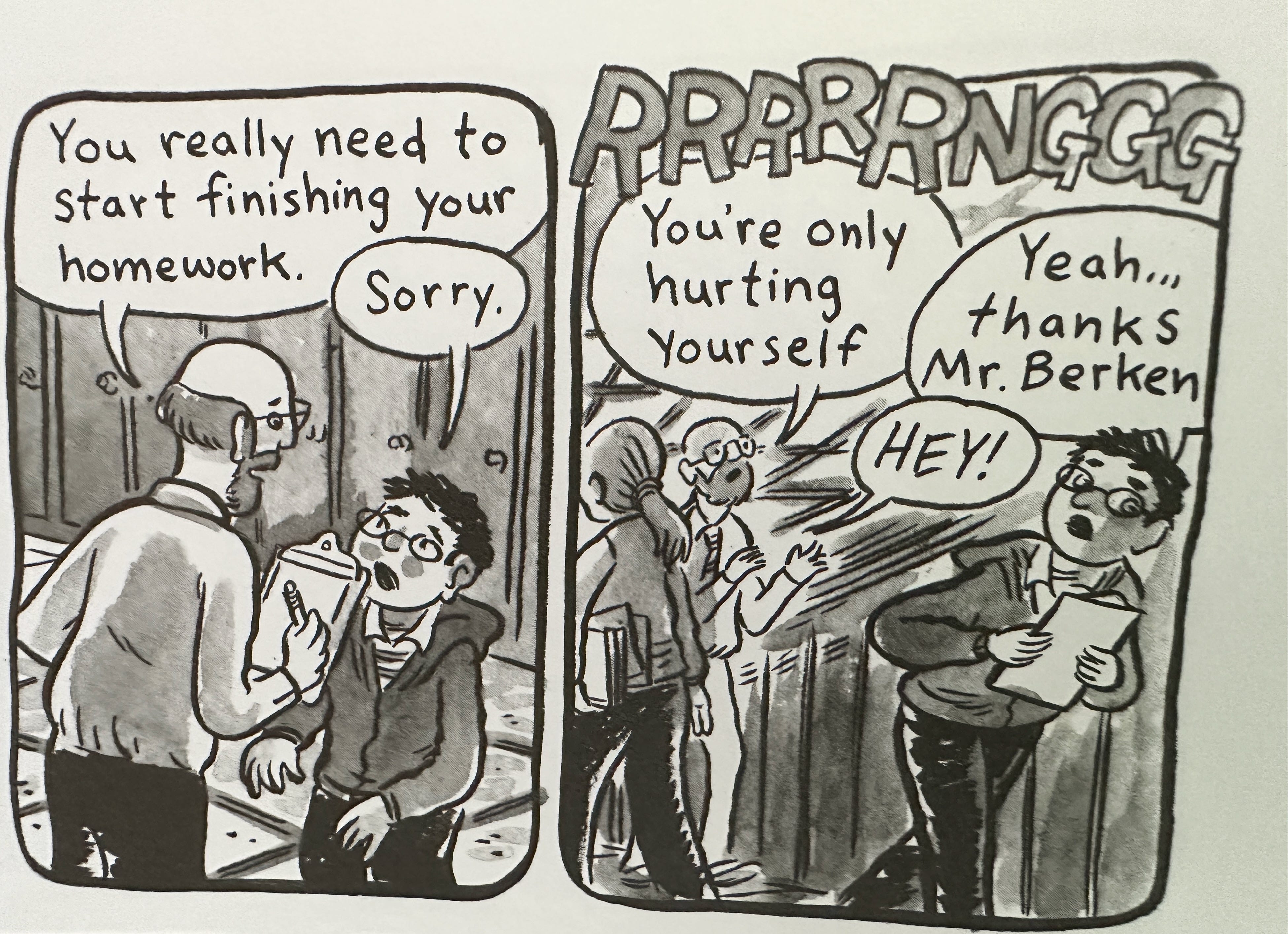
This echoes Denise Pope’s book Doing School, which examines how much of what happens in schools doesn’t reflect “real-world” experiences but rather a closed loop of school culture. Education becomes a Möbius strip—an infinite, self-referential loop. Teachers assign homework simply because that’s what teachers do.
Giving Homework vs. Doing Homework
This brings us back to the question of what the difference is between giving homework and doing homework. First let’s look at the difference between the ideas of extrinsic motivation and intrinsic motivation. Extrinsic motivation comes from external factors—grades, praise, fear of failure. It’s doing something because the teacher tells you to, or because you want an “A.” Intrinsic motivation comes from within—doing something because you genuinely want to do it well.
Ron Berger’s idea of “beautiful work” captures this perfectly: when students take pride in what they create, they’re motivated to produce their best work—not because it’s assigned, but because it matters.
Creating Meaningful Learning
The key is to design projects, papers, or assignments that students want to do their best on. This is part of what motivated me to integrate theater into the classroom. Researcher Shirley Brice Heath talks about the need for adolescents to engage in activities that offer risks, rules, and roles. Performing for an audience provides all three.
The projects my daughter loves bringing home most are from her design class. She might not have time in school to finish them to her satisfaction, so she brings them home to keep working—doing homework, yes, but as a natural extension of authentic in-school learning. The teacher sets a due date for the project but doesn’t assign “homework” in the traditional sense of math problems or vocabulary lists.
Recommendations for Schools
To summarize, here’s what I’d encourage schools to consider:
1. Learn at School
Use classroom time to complete the core work of schooling. Move toward block scheduling (90-minute classes) so students can engage deeply during the school day.
2. Projects, Not Assignments
Design long-term projects instead of daily micro-assignments. Build routines and retrieval practices into the daily-life of classrooms rather than assigning as homework (see Holly Korbey’s The Bell Ringer for a deep dive into these).
3. Monitor Homework Time School-Wide
Develop a sensible, collaborative homework policy that respects students’ time.
4. Beautiful Work
Focus on helping students care about the quality of their work, rather than doing assignments for grades or compliance.
5. Authentic Audiences
Create opportunities for students to share their work with real audiences—their peers, families, or the wider community.
I hope to see my own kids never bring home another vocabulary word search or crossword puzzle. Let’s save that time for the kind of learning—and living—that truly matters.
Hey Kurt! Thanks for writing. Genuinely curious about your thoughts on books. You seemed less declarative on the subject of novels both in the essay and here in the comments. I can't really imagine how much time we would lose for close reading, discussion and line-by-line analysis (nor how many opportunities would be lost for independent meaning-making) if we sat and read the entirety of every book in class, but I'm certainly open to a new perspective if you have one.
Love this: “Education becomes a Möbius strip—an infinite, self-referential loop. Teachers assign homework simply because that’s what teachers do.”
Teaching is so complex— of course we do some things “just because”, without thinking deeply about them— at first. But once we start thinking intentionally about our practices, the ways that they might not really align to our values starts to really become apparent.
I’m writing about educator burnout over at my substack, and encouraging educators not to take home stacks of papers to grade. What follows from that logic is that students shouldn’t have to take home 3 hours of nightly homework either. We’re setting them up for burnout before age 20 when the volume is just so so high.