

Picasso famously said that, as an adult, he learned to draw from his children. Similarly we as adults can learn much from the wonder of a child. Toddlers are fascinated by the smallest of things they find on the ground—leaves, flowers, ants, caterpillars, spiders, bees—these all become objects of questions and conversations. Eleanor Duckworth in her book The Having of Wonderful Ideas, emphasizes the need to shape classrooms around students’ unique observations and insights—instead of giving students the answers, we need to facilitate environments that allow for exploration.
For most of us, when we think back on our science classes (and perhaps on most other disciplines as well), learning consisted of plodding through a textbook, chapter by chapter with assigned readings, punctuated every few weeks by an exam that tested “what we learned.” Those of us that learned how to “do school” sat down with the textbook the night before, memorized all the facts, and spit them out on the test the next day. In my middle school physics class my teacher would “demonstrate” to us the laws of physics in front of the room. The answers were already out there—they had been found—our only job was to memorize them.
Duckworth emphasizes the need to allow students to discover the world on their own. This is exactly what we’ve been doing in classrooms using a very simple approach: begin with students’ questions rather than the answers.
The Nature Seminar
Perhaps the best example of this I’ve seen was in Dan Bisaccio’s classroom. He was a science teacher at Souhegan High School where I had my first teaching job. Every day, his high school students would go out to a plot of land directly behind the school to observe and map the flora and fauna. A description of the course, also taught by humanities teacher Susie Carlisle, reads:
[Students] are also involved in detailed mapping of their 12’ x 12’ quadrants in the Biodiversity plot adjacent to the school and bordering the Souhegan River. This is important field work not only for this course, but because their data is entered into [a] larger international research project monitored by the Smithsonian institute.
I spent some time observing Dan’s class (the school used a structure called Critical Friends which allowed teachers to observe each other’s classrooms throughout the school year). In class, I saw students deeply engaged in questions about nature. The questions were of course rooted in the plot of land behind the school, but they quickly grew to encompass larger questions about birds’ migratory patterns and what might be causing certain plant species to decline. The course didn’t follow a textbook—it was driven by authentic work in the field and the genuine wonderings of the students.
Classroom Applications: The Inquiry Wall
Although Dan and Susie’s class is a beautiful example, we don’t always have the opportunity to take students out of the classroom for field work. An alternative inside of the classroom is to begin with what we refer to as “artifacts.” By “artifacts” we mean engaging, rich, high-quality videos, artworks, texts, and/or objects students can watch, read, and examine. From these artifacts students develop layers and layers of questions.
Begin by designating a space in the classroom as an “Inquiry Wall.” In studying many kinds of inquiry walls in classrooms (easy to find in a Pinterest search), I’ve developed a “less is more” approach.
Designate a line dividing the wall in two (horizontal or vertical). Label one side of the wall, “Questions,” and the other, “Answers.”
As students come up with more and more questions, place them on the “question” side of the wall. As the class finds the answers to the questions, move the questions to the “answer” side of the wall. Simple. That’s it!
What does this do? It will show in many cases we don’t have answers to all the questions that students might ask. For instance, in a unit that involved a NASA probe mission to one of Jupiter’s moons, one of the questions was, “How did the universe begin?” This question can lead to a study of different theories of the origin of the universe, but also reveal the limits of our collective knowledge. This is the kind of experience in schools that might lead students to want to become scientists—to continue to hypothesize and search for possible answers to questions such as these.
(Stay tuned for a description of this unit next week.)
Bees: An Example
Working with the Summit Public Schools outside of Chicago we developed an inquiry approach for a unit on “bees.” We began simply by asking, “What questions do you have about bees?” This immediately gives us a sense of where students are on the topic—some students might have a surprisingly deep knowledge about the topic while others are starting from almost nothing. After we populated the “questions” side of the board with initial wonderings, we showed a portion of the documentary series Our Planet (Season 2, Episode 2 available at the time of this writing on Netflix.) We then asked the questions:
What have we learned?
What new questions do you have?
Looking at our inquiry wall we then pull questions down to the “answer” side and add new questions to the wall.


We then read the book Honeybee by Candace Fleming, illustrated by Eric Rohmann, and continued the process.
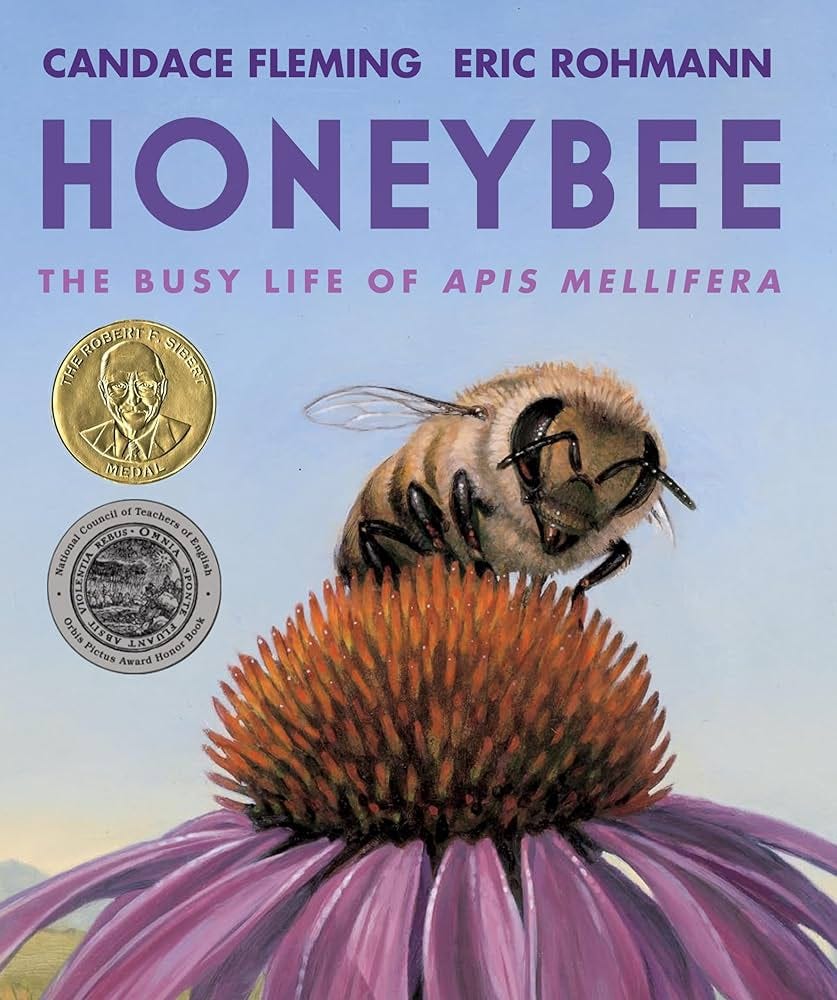
More questions added, more answers found. Then, we had the opportunity to leave the classroom space and visit an actual Apiary, more questions, more answers.
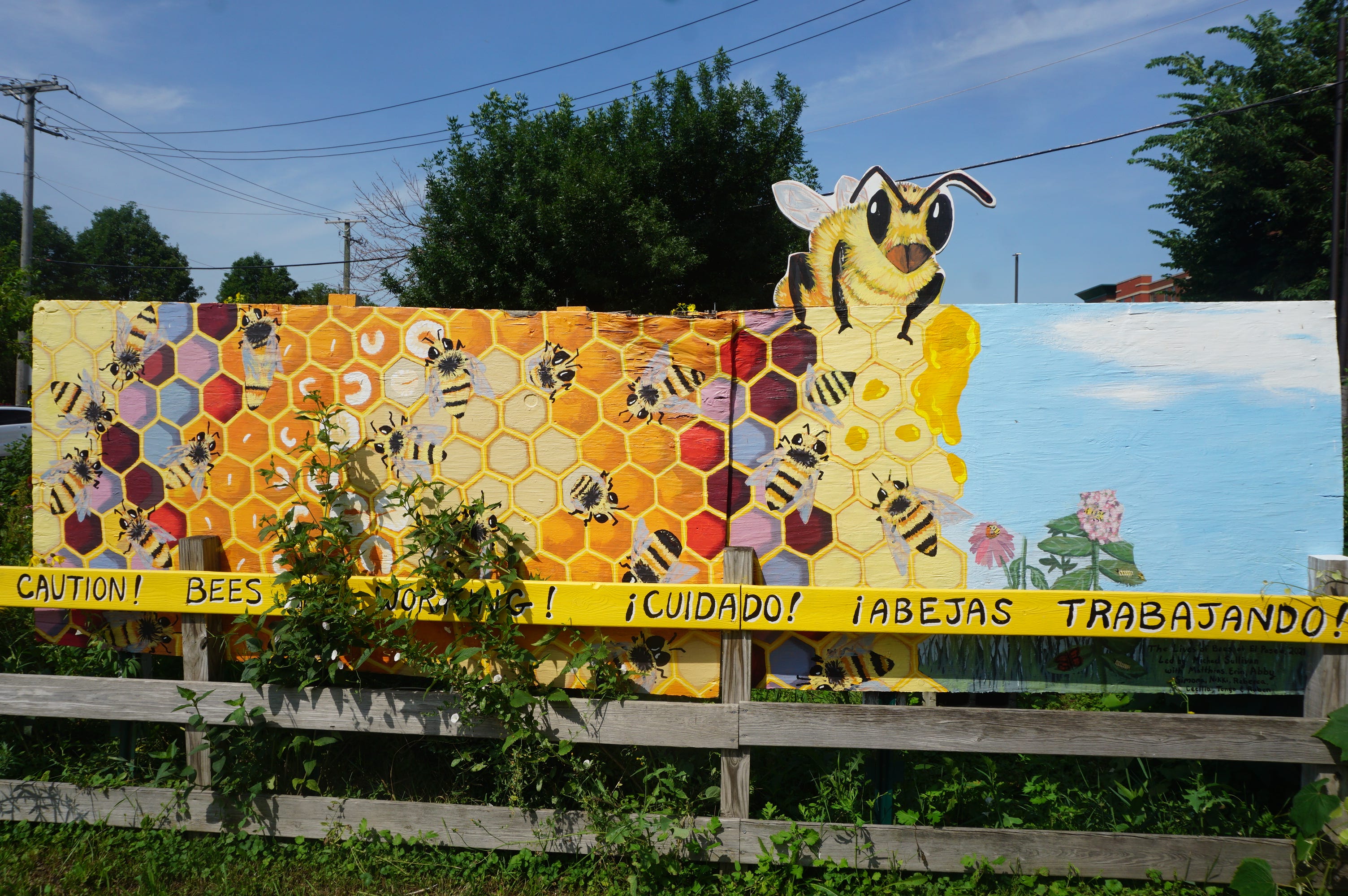
Once enough questions are on the inquiry wall we ask students to arrange them into categories. These naturally emerging categories serve as a roadmap for future through-lines of study. For instance, we might research changes in the global bee populations. Individual students or student groups can take categories they are interested in and pursue their own research presenting their work in an exhibition at the end of the unit.
Real researchers in the real world ask real questions. Our students deserve the same.
Coming Soon! Next week, I’ll show an example of how an interdisciplinary study of our solar system can begin with inquiry.
Thanks Kurt! You have described this inquiry approach in a simple, elegant process. Easy for us to use right away. Question and Answer wall-love it!
Student based inquiry is an “easy” way to make content relevant, to give students ownership of their learning