

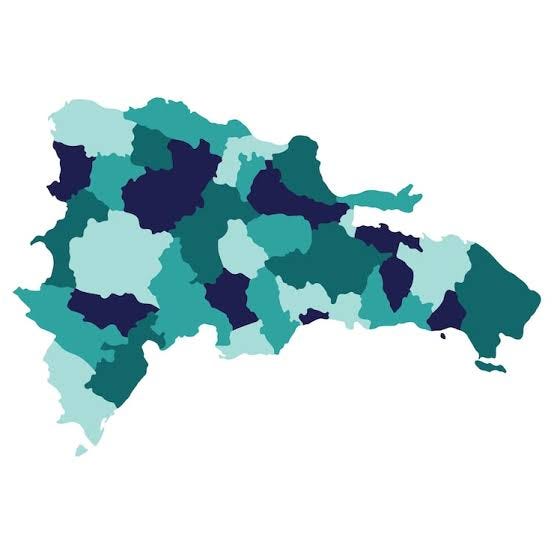
I recently attended a school presentation in which each classroom was assigned to “specialize” in a different country. I was in a classroom focused on the Dominican Republic—students gave presentations on the country and the room was filled with maps, photographs, and cultural objects. I noticed that the map of the Dominican Republic that was displayed only showed the eastern side of the island. Much like the image below.
Overall the students’ presentations were well-done. They spoke about the country’s GNP, the principal exports, and merengue and bachata—all important—but, having visited the D.R. to work in the past—I noticed some glaring omissions.
Afterwards I asked a student I knew well a couple of questions. I pointed to the map and asked if they knew what country bordered the Dominican Republic to the West, sharing the same island. He didn’t. Then I asked if he knew that the Dominican Republic was at one point a dictatorship. He didn’t. This brought to the forefront the question for me in a very real way, “What do students really need to know when they study a particular subject?”
As you’ll see from many of my previous articles—and by the fact that I wrote a book called ENGAGE—much of my work is about student engagement in learning. I want students to be engaged. I want them to have powerful experiences in the classroom. And I want them to leave the classroom knowing things they didn’t know before. Recently it seems like much of the conversation about the “best type of instruction” has been an either/or argument. Either you are for knowledge-based instruction or for experiential education. Teach through inquiry or through direct instruction. I believe we can have the best of both worlds. Skilled teachers weave these practices together into a rich tapestry of reading, thinking, writing, and doing. With that in mind, let’s look at how we might approach ensuring that students leave the classroom knowing more than when they walked through the doorway.
Essential Facts
Whatever subject we're teaching, students need to know a few key facts. For instance, if we are studying the Civil War in the United States I would want them to know at least that Abraham Lincoln was president, that the institution of slavery was a cause of the war, and that it took place in the 1860s. I’d hope they leave with much more knowledge than that, but let’s stick to the essential facts for the moment.
If I was teaching about the Dominican Republic, I would want students to roughly know these key aspects of the country’s history.
The Taíno were an Indigenous people living on the island before Columbus arrived in 1492.
The Dominican Republic shares the island of Hispaniola with Haiti, with which it has a long and sometimes difficult relationship.
The Dominican Republic was colonized by Spain. It later came under Haitian rule before gaining independence in 1844.
The Dominican Republic was ruled by the dictator Rafael Trujillo from 1930 until his assassination in 1961.
I wouldn’t want to ask a student after studying the Civil War who the president was and have them respond “George Washington.” Similarly with any subject area we are teaching students should leave with some basic knowledge.
The problem is historically our students’ learning stops here. How many examples can you think of from your schooling in which the classroom was just based on facts.
One of my favorite quotes is from the fictional character of Thomas Gradgrind, the iconic school board superintendent in Charles Dickens’s Hard Times (just his name alone is perfect).
Teach these boys and girls nothing but Facts. Facts alone are wanted in life. Plant nothing else, and root out everything else.
When I think back to my public school years as a student in Indiana, every history teacher I had taught only the facts. My middle school history teacher would outline his notes about a given subject on the board and our job was to copy down his outline. We were graded only on how perfectly we copied his notes. My high school history teacher worked through the history textbook chapter by chapter and always gave a 50- question multiple-choice test at the end of every chapter. That was how I “learned” United States and World History.
I do think it's important for students to learn essential facts—those few facts they could, and perhaps should, remember for the rest of their lives.
From Facts to Intellectual Frameworks
Those essential facts are important, but they are only a means to the end. What is also critical, and often missing from classrooms, are the “intellectual frameworks” necessary for understanding the central ideas of a given subject area. One of the best courses I took in college was called Intellectual History, a series of lectures and readings led by Professor Izenberg. What I loved about it was that it was interdisciplinary—it showed the connections between the subjects—art, literature, philosophy and history. We would take a topic like Modernism, look at the historic influences of the movement, and study how it played out across different disciplines.
What I primarily learned was how to conceptualize a big idea—an intellectual framework—and apply it across different contexts.
I feel like much of what is missing from education is students learning not just skills and facts, but how to build and work with intellectual frameworks. We might begin with an essential fact. Taking the example above, we learn that the Dominican Republic was under a dictatorship for about thirty years. That might lead to some questions (and, yes, this is when an inquiry-based approach to education is absolutely critical.)
What happened to the average citizen in the D.R. during the dictatorship?
What is a dictatorship and how is it different than other forms of government i.e., democracy?
How did the dictatorship end? How did the D.R. transition into the form of governance it has today? What kind of government does it have today?
These are just a few of the questions that might emerge. These lines of inquiry then can lead us to the intellectual framework we hope students will leave this area of study with. It might be related to having an understanding of how dictatorships come and go in countries and what effect that has (a particularly important topic in Latin American studies).
Choosing another fact our unit of study might head in a different direction. Learning that the Taíno were living on the island when Columbus arrived, we might ask:
What was the relationship between Columbus and the Taíno people?
How did European colonization affect the Taíno and their communities?
What can we learn about Taíno culture and its continuing influence in the Caribbean today?
These questions might lead students to a larger intellectual framework for understanding colonialism across different regions, raising the question, “What were the consequences of European colonization for the Indigenous peoples of the Americas?”
In their groundbreaking book Understanding by Design, Grant Wiggins and Jay McTighe introduce the concept of “enduring understanding.” They write:
The term enduring refers to the big ideas, the important understandings, that we want students to “get inside of” and retain after they’ve forgotten many of the details.1
Although Intellectual Frameworks are a form of enduring understanding, I don’t think all enduring understandings are intellectual frameworks. An enduring understanding is an important idea we want students to remember long after a unit has ended. An intellectual framework is an interconnected set of ideas students can use to understand new subjects and systems.
Let’s look at a different subject besides history. We might read The Great Gatsby with our students. We’d be happy for them to remember that it’s written by F. Scott Fitzgerald and takes place during the 1920s, but that isn’t the reason we read it. Perhaps we might want students to really look at the symbolism of the story. We don’t need for them to remember what color of the light Gatsby sees across the dock (green— perhaps useful only for a Trivial Pursuit question). What we do need for them to understand is how writers, painters, filmmakers, songwriters use symbolism in storytelling. When is an object a symbol and when is it only an object? How as viewers or readers can we know? Understanding the complexities of symbolism is a literary framework students can apply to works of art throughout their lives.
Moving to mathematics, we often enter the classroom to learn a new concept—the Pythagorean theorem, sine and cosine, parabolas—and proceed to work through a series of problems without really understanding the larger intellectual framework. Take parabolas, for instance. Students might learn to graph quadratic equations and calculate their vertices, but what larger ideas are they developing? A study of parabolas could lead to an investigation of how mathematical functions describe relationships and help us predict patterns in the world. I visited a 10th grade classroom at High Tech High Mesa in San Diego in which students were doing just that. After learning about parabolas and practicing equations, they built small rockets, launched and filmed them, and calculated the parabolas. The students were certainly learning how to solve equations, and they were developing a mathematical framework for understanding everything from the trajectory of a golf ball to the design of a bridge.



David Perkins, in his book Making Learning Whole uses baseball as a metaphor for education. He explains that the way we often teach is like teaching the rules of baseball without ever letting students play the game. He refers to the concept of “elementitis” as teaching the pieces of a subject without ever letting students experience the whole—for example, teaching students the formula for parabolas without letting them see how they apply to students’ lived experiences. In the High Tech High classroom they were doing both—again, the best of both worlds.
Facts to Frameworks in Practice
Here I’ll provide a planning process for thinking about how intellectual frameworks might serve as a guide for learning. We can envision this as a three-part process:
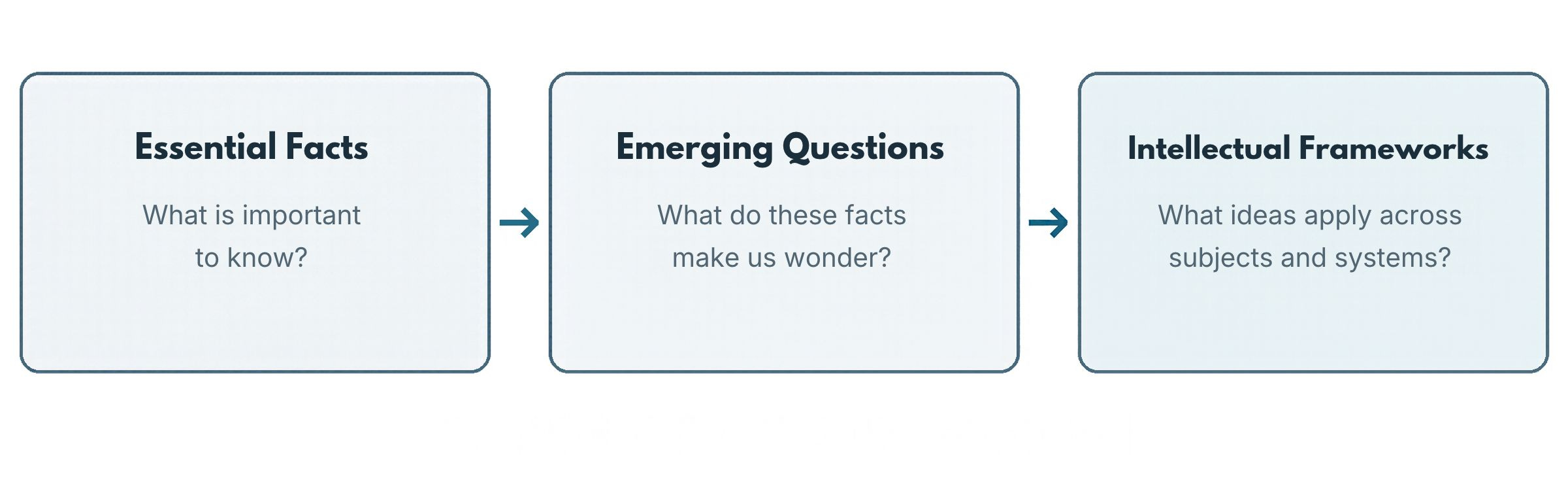
The goal is to move from a group of facts (important, but not the end in themselves) to ways of thinking that help us understand the larger world.
1. Essential Facts: What is important to know? Identify about five essential facts.
2. Emerging Questions: What do these facts make us wonder? What are the questions that inspire deeper investigation?
3. Intellectual Frameworks: From the questions and facts, what larger ideas emerge? Develop interconnected understandings that can be applied across different historical situations, art forms, and/or mathematical/scientific systems.
This will vary considerably by grade-level. In younger grades begin by teaching the key facts. Then see what questions students have about those facts. Finally introduce the intellectual framework the class will focus on. This all might happen in the first day or two of introducing a topic of study.
For older students, we could even make finding the essential facts an intellectual activity in itself. In a biology class studying photosynthesis, we might ask, “What are the five most important facts someone should know about photosynthesis?” Students could spend a class researching, drawing diagrams, and taking notes before reaching a consensus in groups about which facts are most important (see Research Boards). From there, we would investigate the questions that emerge from those facts and introduce a larger intellectual framework: how living systems transform energy. This framework could then help students understand other biological processes, such as cellular respiration, and eventually explore how energy flows through entire ecosystems.
I can also see this process working as part of a teachers’ planning and design process in order to really focus on what is worth teaching about a topic. My colleague and co-author Eileen Landay would always encourage us to think about the why. Why are we asking students to do this activity? Why are we teaching this topic? For me, these questions lead back to what we hope students will take with them long after they’ve left our classrooms. We want students to leave our classrooms knowing more about the world around them, with the intellectual frameworks to make sense of that knowledge, and the desire to use what they've learned to make the world a better place.
Wiggins, Grant and Jay McTighe. Understanding by Design, 1998. p. 10
From Facts to Frameworks, gracias Kurt. The idea of frameworks helps me better stand and express the why I teach what I teach