

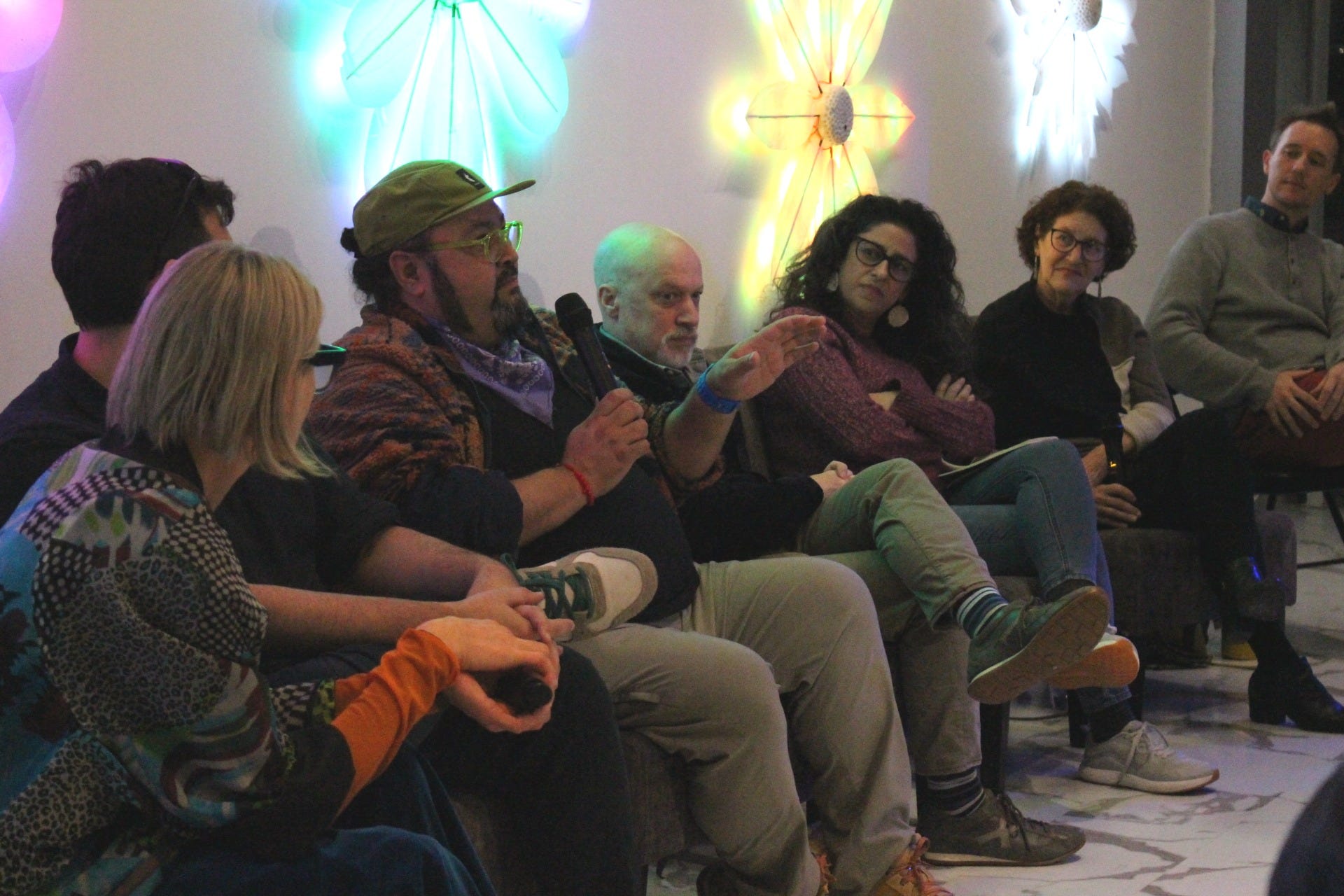
Recently I was on a panel in Chicago at the Forum 301 gallery. The topic of the night was the role of art in society and education. Many of the other participants on the panel were professional visual artists. Although I might say that I’m an actor or theater director, it’s actually been over thirty years since I’ve directed a conventional play. So when questions were asked about “the process of an artist” and ways we might “look more deeply at art,” I sat listening, at first feeling that, since I’m not a formal artist, and especially not a visual artist, the answers were best left up to the others.
Other colleagues of mine, seeing that I wasn’t speaking much, kept handing me the mic encouraging me to answer some of these questions. Then something clicked. When I did direct theater, I felt my role was to guide a community of people—actors, designers, tech crew—towards a shared vision with a clear goal. Although I always had a few initial ideas about what some elements of the production might look like, I preferred to collaborate by asking questions of the ensemble and exploring what might be possible. Then, over the few weeks, we would arrive at answers in the form of sets, costumes, lighting, sound, and character choices.
Isn’t this the same thing we do as teachers—ask questions and explore a topic or text until we arrive at a place where the students can share their own understanding?
Teaching as Theatre
As a teacher, my question of the room is always, “What will we be able to achieve as a community?” My second teaching experience was as an English teacher at Hope High School in Providence, RI in the 90s. Recently, Anne Deavere Smith had performed and published her play Fires in the Mirror. In the play, Deavere Smith created a one-woman documentary theater piece by conducting interviews with people affected by the Crown Heights uprising of 1991. She then organized and edited the interviews into a series of continuous monologues in the voice of the interviewees.
My students and I read the script and watched selections of her play (on VHS!). I asked my students if they’d be interested in doing a similar project this semester as a class. They enthusiastically agreed (knowing the alternative would be diving into another extended novel - we had just finished reading Black Boy by Richard Wright). We came up with a research question together, “When do you feel seen and known in Providence?” Students interviewed family, friends, and neighbors and, similar to Deavere Smith, selected the interviews they wanted to highlight, edited them to create a script, and then rehearsed and performed for the school community.
For me this changed the dynamic from my first teaching job where I generally felt my role was to “teach” stuff and students were expected to show their understanding of it. My first forays into teaching were almost purely content-based. I thought my role was to be as animated as possible, essentially performing for students at the front of the room and getting them excited about Shakespeare, Gatsby, or whatever the subject of the day might be.
Reflecting on this during the panel discussion, I took the mic and told the audience that I do see myself as an artist—but not in the traditional sense of someone working alone in a studio. Teaching, for me, is an art. It is a collaborative art form in which a classroom community creates something new and original. I still see myself more as a theatrical “director” than a traditional “teacher” or “facilitator.” Together we work toward a shared goal, and it’s my role to lead us there as elegantly and gently as possible.
Knowing the Destination
Ted Sizer’s work in the 1990s introduced me to the idea of exhibitions of learning. An exhibition is a way for students to demonstrate their understanding of the content for an authentic audience.
In his book Horace’s School: Redesigning the American High School he wrote:
Exhibitions can be powerful incentives for students. Knowing where the destination is always helps in getting there, and if that destination is cast in an interesting way, one is more likely to care about reaching it.
Sizer’s words reminded me what it means to lead a theater ensemble and crew. We have a shared understanding of what the destination is. We have a deadline. And so, as a classroom, we work towards that end with a sense of urgency and purpose. After encountering Sizer’s work in my second year of teaching, I knew we needed that same sense of shared purpose as teachers and students.
And so over the years I’ve created hundreds of exhibitions of learning with young people, with teachers, and even with parents.
We Pin Quick Wishes on the Stars
Most recently Beth Martin, the principal at North Star Elementary School in Bend, Oregon, asked me to stay after a day of working with her teachers for the evening parent meeting. The goal was to introduce parents to the ArtsLiteracy approach to teaching texts.1
At the beginning of our gathering in the school library, the thirty or so parents sat comfortably with the people they knew. After a brief introduction, I asked them to rise from their seats, find someone they didn’t know. We began the session with an activity called Quick Memories, sharing stories about the topic at hand, “the night sky.” We read the poem In Praise of Mystery by Ada Limón that was inscribed on the Europa clipper mission. Part of the poem reads:
we point to the planets we know,
we pin quick wishes on the stars
At the end of our session I asked the parents to think about what wishes they would “pin on the stars” for their own child or children. Our final exhibition, for just a one hour session, was reading their wishes for their children and hanging them on a tree.
The next day a parent stopped me in the front office and said, “You know we came to the meeting expecting one thing, we had no idea we were going to experience that. We couldn’t stop talking about it all night!” I’ve found that these shared exhibitions (when done well) elevate learning to a point where students remember the content precisely because they remember the experience. Learning isn’t just “doing school” in Denise Pope’s words.
The idea of the Exhibition gave me, as a teacher, permission to bring all I’d learned in directing theater to the classroom: a shared sense of purpose, the wrestling with and discussing of complex texts, the need for a shared and supportive community, and most importantly the chance for students to bring their total selves to the room.
At times someone will ask me if I miss directing theater. I don’t. Every time we step into a room together as teachers and learners, we have the chance to create something extraordinary.
Resources
Ada Limón discussing her poem, “In Praise of Mystery”
This video is a great introduction to the overall NASA clipper mission
Anna Deavere Smith, Fires in the Mirror (you nearly get the VHS experience!)
This is a teaching approach developed by a group of teachers, artists, and students twenty-five years ago in the Education Department at Brown University. From this work, Eileen Landay and I designed the framework, The Performance Cycle, described in detail in our books A Reason To Read and Engage.
Wowww, very inspiring thank you