

If I could make the background color to this post purple, I would.
Recently, I came across a list the drummer Questlove put together for Rolling Stone—his top 100 Prince songs. Having been a Prince fan since middle school when he released 1999, I opened the list expecting the usual hits. What I found instead was a selection of many cuts I’d never heard, along with Questlove’s reflections on how the songs shaped him, his listening experiences with Prince in his younger days, and how he sees Prince’s impact across multiple genres of music.

This week, while walking my dog, I worked my way through Questlove’s list, reading every entry and listening to each song in order counting down from 100. So, on the 10th anniversary of his death, Prince has been on my mind. As I was thinking about what to write here, I realized that Prince has had an influence on my teaching, perhaps quietly, behind-the-scenes, but an influence none the less.
Prince’s Unique Culture
When you listen to the song Purple Music, you’ll hear Prince experimenting with the idea of a new sound he describes with only one word, “purple.” (perhaps influenced by Miles Davis’s “blue” period in jazz most pronounced on his album, Kind of Blue). Prince’s purple sound would come to fruition in the movie and its even more influential soundtrack, Purple Rain. Questlove notes that Prince’s sound “isn’t funk, rock, jazz, or fusion. It isn’t pop or Latin. It’s just Prince.”
It wasn’t only Prince’s sound that was unique. He developed his own lexicography replacing words with icons (for instance the song “I Would Die 4 U” and most notably his own name).

In addition, in the realm of fashion, his outfits were all custom designed, and strikingly original. He explains his approach to style:
“Style is not lusting after someone because they’re cool, style is loving yourself till everyone else does too.”
In all his creative efforts—his forays into filmmaking, album cover art, even in building his own architectural world at Paisley Park Studios—he created a unique and cohesive culture that infused all of his work.
A Unique Classroom Culture
At the center of Prince’s work is a defining concept: “purple music.” What would it mean for our classrooms to be shaped by a similarly clear idea, so that when students enter the space, they know they’re not just “doing school”?1
Typically when we reflect on a classroom’s culture it is defined by either the subject-matter or the teacher’s reputation. We all can remember entering the dreaded “Mr. Myers” classroom who had a reputation for being the meanest teacher in the school, or we had to go to American History class where we would spend the year methodically working our way through the district-required textbook. Either way we knew we were at school doing the usual school business, nothing inspired, nothing to make us want to get out of bed and go to school every day.
Taking a lesson from Prince we might consider the questions: How can we, as teachers, create our own “purple music”? How can we intentionally design classrooms that are distinct and lead students to the heart of the disciplines we teach?
Here are a few teachers with answers.
1. The Shadows of Fergus: A Guiding Concept
Perhaps one of the best example I’ve seen of creating a clear, guiding concept for the classroom is in a beginning of the year routine. Adrian writes about his first day of school with his 5th graders:
The first day of school for all students! When students arrived, they found on their tables a one-page explanation of the origins of the name of our classroom. We read W.B. Yeats’ poem, Who Goes With Fergus? and spent the morning discussing its meaning, metaphors, and how it is connected to our classroom, The Shadows of Fergus.
First, I love that his classroom has a name, The Shadows of Fergus, and that this name has a purpose behind it that defines his classroom’s culture, which is, at the essence, “to be your full, authentic self.” Adrian also builds his classroom culture through a shared close reading of Yeat’s poem, modeling his high expectations for students to bring their full selves to complex texts.
2. Raggedy Ann and Andy: The Passionate Teacher
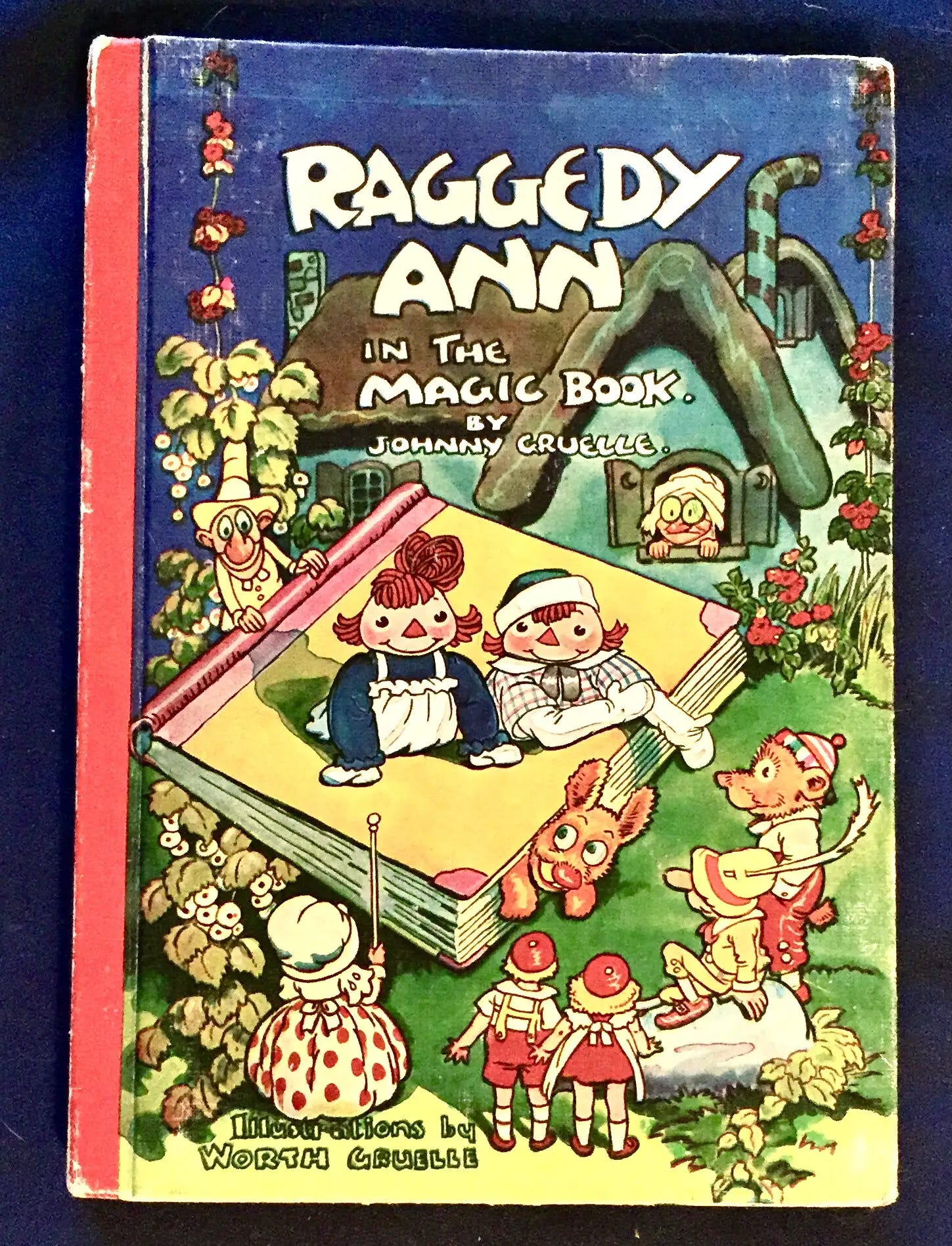
My first foray into public education was as a little 1st grader walking into the classroom of Mrs. Patty Deig. The room was full of decorations of Raggedy Ann and Andy. Raggedy Ann was a doll from 1915 that then became the lead character in a series of books, the first of which Raggedy Ann Stories, was published in 1918. First off, let me tell you I wasn’t into Raggedy Ann. I went to school that first day with my Spider-Man lunch box and, as a first grader in 1977, I was obsessed with a movie that came out the previous Spring, Star Wars. And yet Mrs. Deig’s passion for Raggedy Ann was infectious. She’d begin the day at the piano every morning and we’d sing along to a series of songs. Then we’d transition to the rug for read-alouds. Often the books she selected were from the Raggedy Ann series.
Now if this feels dated to you I can tell you that it felt that way to me at the time as well. But that’s not really the point. Even though I personally didn’t have much inherent interest in these books, her passion for reading, and centering her classroom on books she cared about, showed all of us what it means to be a reader. Yes, she taught us phonics and how to read as well. But it was her passion for the act of reading itself and how she modeled that in the overall classroom’s zeitgeist that showed us how we too could be passionate readers.
One of the books that was the earliest influences in my teaching was Robert Fried’s The Passionate Teacher. Fried writes,
To be a passionate teacher is to be someone in love with a field of knowledge, deeply stirred by issues and ideas that challenge our world, drawn to the dilemmas and potentials of the young people who come into class each day—or captivated by all of these.
More recently, here on substack, Jared Fox has begun a series of posts about “Passion-Driven Pedagogy.” This series, just beginning, is meant to, in his words,
“encourage educators to find the space and courage to bring what they are most interested in into their classroom. For me, one example of this meant teaching about the history and science of New York City’s water supply and waterways—topics that allowed me to share my own love of nature alongside my students.”
Most importantly, as these examples demonstrate, passionate ideas also should be at the very center of the discipline, what Fried describes as being “in love with the field of knowledge.”
A professor of history at my college was in love with baseball. His lectures on Roman History were often peppered with tangents about baseball, not at all related to the subject-matter at hand. Passion for passion’s sake isn’t the goal here. It’s using our passion for a subject area to create our own “purple music,” a guiding concept that signals to students what is at the heart of our teaching and why we care.
3. Dan the Science Man: Fostering a Love of Nature
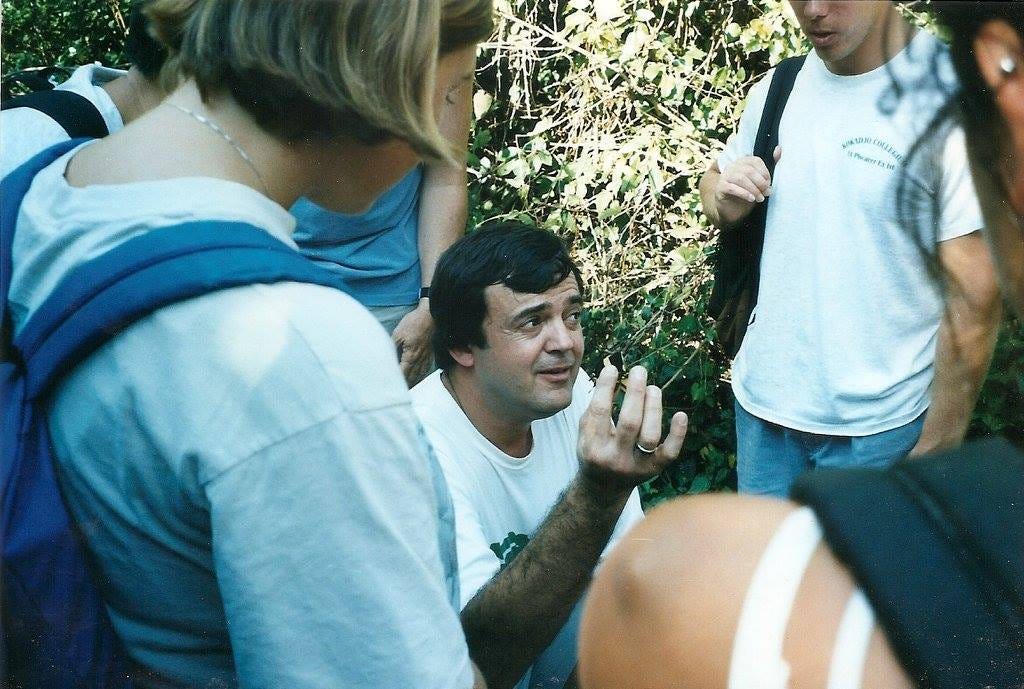
Biology teacher Dan Bisaccio’s classroom was base camp. His students knew they wouldn’t be there long. It was a space for gathering up everyone to head out on an adventure. The adventures consisted of research projects in the woods around the high school. Dan partnered with the Smithsonian Museum to monitor a permanent biodiversity plot near the high school as part of the SIMAB program (Smithsonian Institution’s Monitoring and Assessment of Biodiversity). SIMAB is a program built for scientists doing actual scientific work. Every year, Dan trained his students in how scientists track biodiversity by working alongside them in the woods. He also took his students on trips around the world, working on parallel biodiversity sites in Costa Rica, Belize, Saba, Jamaica, and Mexico (I worked with him and his students at El Eden Bio-Reserve in Quintana Roo, Yucatan).
Dan’s “purple music” was one phrase he told me when I visited his classroom. This was when the “standards movement” was just beginning in the late 90s and disciplines were defined by seemingly infinite lists of standard skills students should master in every discipline. He said,
I have one standard, for students to love nature.
For students to love nature, Dan realized that they need to have a deep understanding of how things work in the natural world and engage in the work of actual scientists.2 You can see that from the photos that Dan has a great passion for nature. Even in retirement, he leads field walks in his small town of Troy, New Hampshire, open to anyone who wants to join.
Your Purple Music
Prince teaches us through his concept of “purple music” that by bringing disparate elements together, by experimentation and fine-tuning his sound, and by working through multiple modalities, he could create something unique.
The examples I’ve offered show the same is possible for our teaching.
For Adrian, it’s the idea of becoming your full, authentic self through language and literature. For Mrs. Deig, it was a lived love of reading. For Dan, it was a ongoing relationship to the natural world beyond the classroom walls.
What strikes me is that all of these examples emerge from finding the center of the content we’re teaching and building immersive learning experiences from that center.
To find our own purple music we might ask ourselves:
What do I want students to understand deeply about this subject by the end of the year?
What in my content are is really worth caring about?
As a community, we are spending many hours of our lives together. What is most important in our shared space? What really matters?
When designing a unit Rob Fried asks us to consider our personal stake. He asks, “What would you say to students about why this unit is personally meaningful to you?” Similarly in Understanding by Design, authors Wiggins and McTighe encourage us to consider the enduring understanding of what we are teaching—focusing on what the foundation is for the content we are teaching. This is the work of finding our own “purple music,” the defining idea at the center of our teaching.
Thanks for reading to the end. Enjoy some Purple Music! (and please note that many of Prince’s songs aren’t appropriate to play in classrooms, including the song “Purple Music!”)
This phrase is from Stanford professor Denise Pope’s book of the same name.
Much recent discussion has been around the idea that we shouldn’t have students do the work of scientists, that they need much more training, more understanding of the fundamental skills, more years of working through academic coursework. Dan Willingham writes, “A more modest and realistic goal for students is knowledge comprehension.” Students certainly don’t have the body of knowledge and experience of an expert in the field, but this doesn’t mean they can’t participate in authentic scientific tasks. The same is true of acting. Consider a professional actor having worked years in the field, Meryl Streep for instance. A younger actor might not be able to bring the body of knowledge she brings to the table, but if we think that young actors can’t do authentic, meaningful, and professional work, we wouldn’t have Stranger Things and a host of young Oscar nominees and winners including Haley Joel Osment in The Sixth Sense at 11 years old and Quvenzhané Wallis in Beasts of the Southern Wild at 9-year-old.
Wow! Never in my wildest dreams did I ever imagine that my classroom would be mentioned in the same sentence as Prince! This idea, creating purple classrooms with purple pedagogy, is so clever. Prince is literally the antithesis of standardization and I'm honored to be in any sort of proximity to his creative genius. Thanks!
Really enjoyed reading about these ideas around teacher personality, meaningful cross curricular learning and the importance of enduring understanding. I'd be curious to hear your thoughts on how this concept of fostering a 'purple pedagogy' can exist within the standardised frameworks and regulations of a typical school? I'm sure all teachers would ideally want to utilise their own coloured pedagogy, rather than being another Mr Myers. Do you see this being a difficult tension to navigate? Many thanks again