

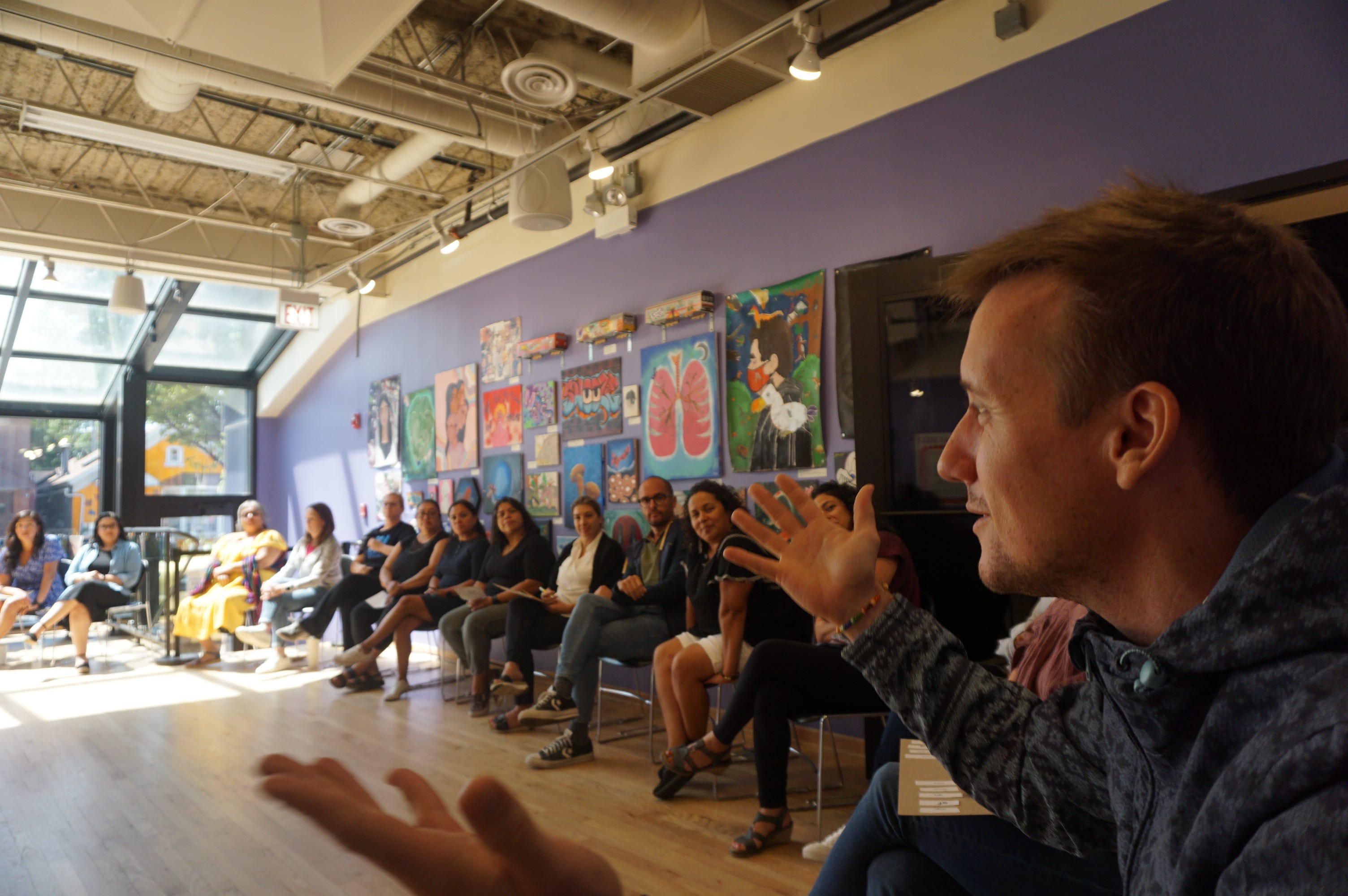
Most of my work now is facilitating professional development workshops and institutes for educators—teachers, school administrators, and community members. I’m usually co-facilitating with colleagues from Habla or collaborative partners in the communities we work in.
Although these lessons are drawn from the education field, they apply broadly to anyone leading groups. I’ve made many of these mistakes myself, especially when I first began teaching and leading workshops almost thirty-five years ago. I hope these lessons help anyone preparing to present or facilitate, whether it’s at a conference or in front of colleagues.
Begin with Quick and Engaging Introductions
Asking everyone in the room to introduce themselves—with no structure—can take 20-30 minutes. Instead ask participants to “whip” around the circle quickly, sharing only their name and one other thing (where they’re from, what they do, or what they teach). For more ways to kick off a session, try Rapid Bios or some of the activities from our book ENGAGE: Spooky Spock, My Superpower, Gestures of Greeting, and If You Knew Me You Would Know (pictured above).
Adapt to the Moment
A theater director once taught me that there are no mistakes on stage—when something unexpected happens, adapt and carry on. When we’re facilitating we might fall behind on time—perhaps a discussion runs long or an activity takes longer than expected. Look at your plan, adjust as needed, cut if necessary, and keep going as if it was all designed that way from the start.
Talk Less, Invite More
When we ran a lab school at Brown University, we measured how long students stayed engaged during teacher talk. Seven minutes. That was about the limit before attention started to drift. Adults are no different. I try to keep any direct instruction under seven minutes. The best moments in workshops are when participants are actively doing, not when I’m talking.
Let Slides Be the Background, Not the Script
We’ve all sat through presentations where the presenter reads their slides word for word. I use slides as a backdrop to the story I’m telling or to the instructions I’m giving. I remember watching Steve Jobs present new Apple products—the huge screen, the product animations, the storytelling. At a more modest scale I’ve adapted the idea: I look for compelling images, quotes, or short animations to complement what I’m saying.
Always Use the Mic
For years I resisted using microphones. I thought I projected well enough. Then a co-facilitator pointed out that someone in the room might be hard of hearing and could benefit from a mic. Since then, I always use a mic if available. It also helps preserve my voice during longer institutes.
Treat Participants as Respected Colleagues
Everyone in the room has a full life—kids, parents, deadlines, emergencies. I remind people: “Take care of yourselves.” Step out if you need to. Check your phone if it’s urgent. Skip an activity if you’re not up for it for any reason. We’re all adults here and, as long as we respect the community space, participants can manage their own needs.
Ask Open Questions
A classic scene in Ferris Bueller’s Day Off shows an economics teacher asking questions with “correct” answers—and then immediately answering them himself. Questions with a single correct answer shut down conversation and exploration. Good questions don’t test knowledge—they spark conversation. They invite participants to share their stories and experiences and build on each other’s ideas.
Build Structures that Let Everyone Speak
Every group has a few people who love to talk—and a few who’d rather not. Without structure, the loudest voices win. I’ve found that thinking routines like “Think–Pair–Share” or short written reflections give everyone a chance to gather their thoughts and be heard.
Bring the Session to a Strong Close
Never look at the clock and be surprised that you’ve run out of time. Always have a quick, powerful ending in mind for any session. I typically leave five minutes for an ending wrap-up. I might ask participants to gather in a circle and perhaps share a “takeaway” from the session with one word or phrase. A quick, intentional ending provides closure.
End Right on Time
Going over the allocated time implicitly says, “My time is more important than yours.” Always end sessions on time, even if that means trimming an activity (see Adapt to the Moment above). Respecting participants’ time shows professionalism and care.
I’d also apply all of these to any class I’m teaching—because whether you are facilitating an experience with 4 or 400 people—it’s really all about creating a space where people can think, create, and learn together as a community.
#5 contribution: the research says amplified voices trigger something in our brains making it easier for us to get engaged and stay engaged. This is another example of assistive tech that starts for one group of people yet is effective for all people.
Very helpful Kurt, thank you